From Patient Case to HCP Journey: Making Every Congress Touchpoint Relevant
About the webinar
Pharma congress journeys are mostly built around the company. The booth, the logo, the speaker, the invite. HCPs walk past.
The teams getting real engagement start somewhere different: with the patient the HCP saw that morning.
In this on-demand episode, Pierre Metrailler and Anna Omstedt walk through what patient-centric congress engagement actually looks like in practice, from a single clinical question at the booth to a connected journey that syncs back to Veeva or Salesforce.
Anna opened with a simple diagnosis. Pharma teams spend significant money on booths, symposia, and screens. Then they show up and talk about themselves. The invitation says “Pharma A is at EHA.” The booth hands out a brochure. The QR code goes to a product page.
HCPs walk past.
The fix isn’t a better brochure. It’s starting with the patient.
What patient case-based engagement actually looks like
Anna walked through a live example from a company that used MedUniverse at Neurology Week in Stockholm. One question per day. Simple content, easy to get through MLR. But interactive, so HCPs could respond and see how their peers answered.
50% got the answer wrong. That’s not a failure. That’s a conversation starter. It gave the rep something real to say. It gave the HCP a reason to stay.
Anna then ran the room through a live patient case, Harold, 54, with a caffeine dependence that probably mirrors your inbox on congress week. The point wasn’t the humor. It was to show what activation feels like from the HCP’s side: a clinical question, a decision point, a percentage of peers who got it wrong, and a natural call to action at the end.
Read the full report
Pierre showed how the same mechanics apply across formats. A patient case doesn’t have to live only in a symposium. It can appear on a coffee cup, a screen, a QR code at registration.
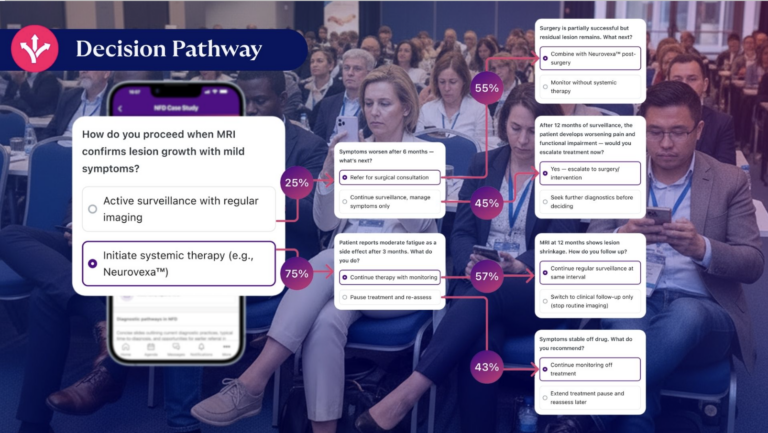
But passive exposure isn’t the goal. Pierre walked through how Onomi approaches this differently: instead of putting an HCP in front of content and hoping it lands, the formats are designed so the HCP is making decisions. Choosing a path through a case. Seeing where their peers went differently. Understanding why.
In oncology especially, there’s rarely a right or wrong answer. The value isn’t in the quiz score. It’s in understanding why a group of HCPs went one way and another group went somewhere else. Was it geography? A drug that isn’t approved in their country? A different patient profile? That’s the signal. And it only surfaces when the HCP is active, not scrolling.
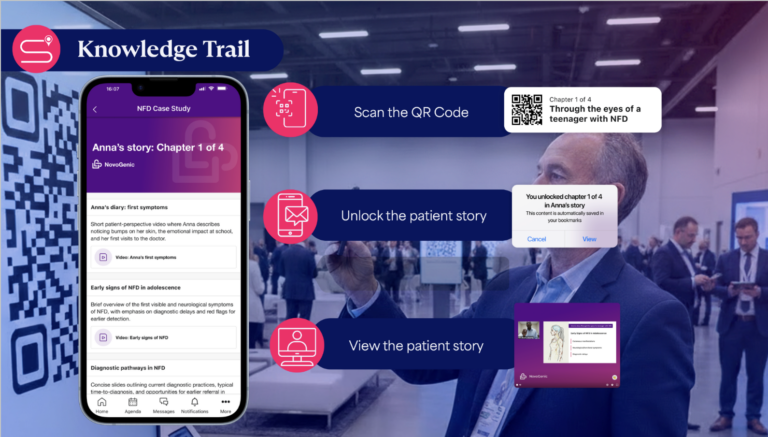
Pierre also described a second format: the knowledge trail. A background case that runs as a thread through multiple booth touchpoints. An HCP can pick it up, put it down, come back to it. One or two messages stay front and center across the whole experience, which means better recall and a follow-up that feels like a natural next step rather than a generic thank-you.
The journey, not just the touchpoint
Pierre’s framing: a single congress generates around 150 potential touchpoints. A pharma team can realistically own 30 to 40 of them. The question is whether those 30 to 40 form a journey or a pile.
The session mapped what a connected journey looks like in practice: a booth conversation that leads to a thank-you email that suggests the symposium, a knowledge quiz at the symposium that measures pre and post, a follow-up that feels earned because the interaction actually happened.
Anna’s point on credibility: keep the content relevant, bring in the full clinical picture including competitive context, and stay focused on the questions you actually need answers to. HCPs will tell you immediately if it doesn’t feel real.
Where the CRM comes in
Pierre brought the Onomi angle. The insight from a patient case interaction, the answer an HCP gave, the question they asked, the path they chose, doesn’t have to disappear when the congress ends. Engagement signals can be resolved to HCP identity and synced into Veeva or Salesforce in real time. That’s what turns a single congress interaction into the starting point for the next one. The follow-up doesn’t have to be “thanks for visiting the booth.” It can reference what the HCP actually did.
Speakers
- Anna Omstedt - CEO, MedUniverse
- Pierre Metrailler - CEO, Onomi