
One front door for every meeting request
Meetings get decided in corridors and requested by email, so compliance is a retrofit and the budget is a guess. With Onomi, every meeting type starts on one form, routes to the right approvers by policy, and carries its budget from request to reconciliation.
Runs across everyday HCP meetings, congress attendance requests, and speaker programs on Onomi 360 MeetingsEQ.
Where meeting intake breaks down
Requests start three steps too late
The meeting was agreed in a corridor conversation weeks ago. By the time a form is filled in, the venue is booked, compliance is a retrofit, and the budget is whatever the agency quoted.
Approvals live in a mailbox
Who signs off depends on who remembers the SOP. Compliance review is a forwarded email, escalation is a chaser, and reconstructing why a meeting was approved takes an afternoon.
The budget is discovered at reconciliation
Cost is estimated at request, committed somewhere else, and reconciled months later in a spreadsheet. Nobody can say what a meeting actually cost until finance closes the quarter.
Every market has its own template
One country runs a Word form, another an intranet page, a third asks the agency. The same meeting type gets four different questions, four routing paths, and no comparable data.
How it works
One front door, whatever the meeting
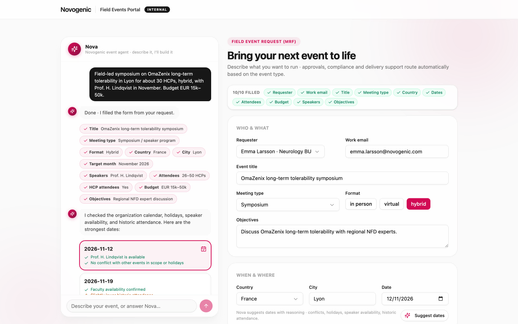
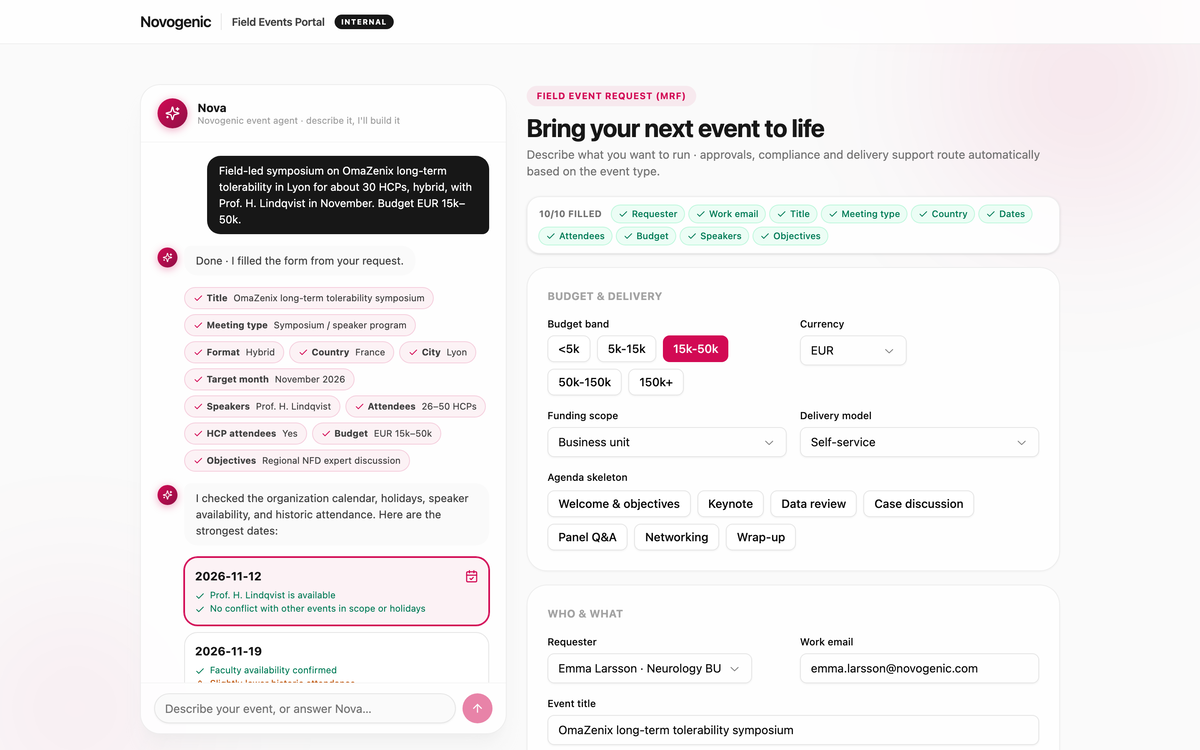
The request form branches by category, so a dinner meeting, a symposium, and a congress attendance request each ask their own questions on the same record model. Occasional requesters submit and track through a no-license self-service lane, a duplicate-last-event shortcut reuses last quarter's setup, and AI-assisted creation drafts the request from one plain-language sentence, for the requester to review.
Approvals as configuration, not code
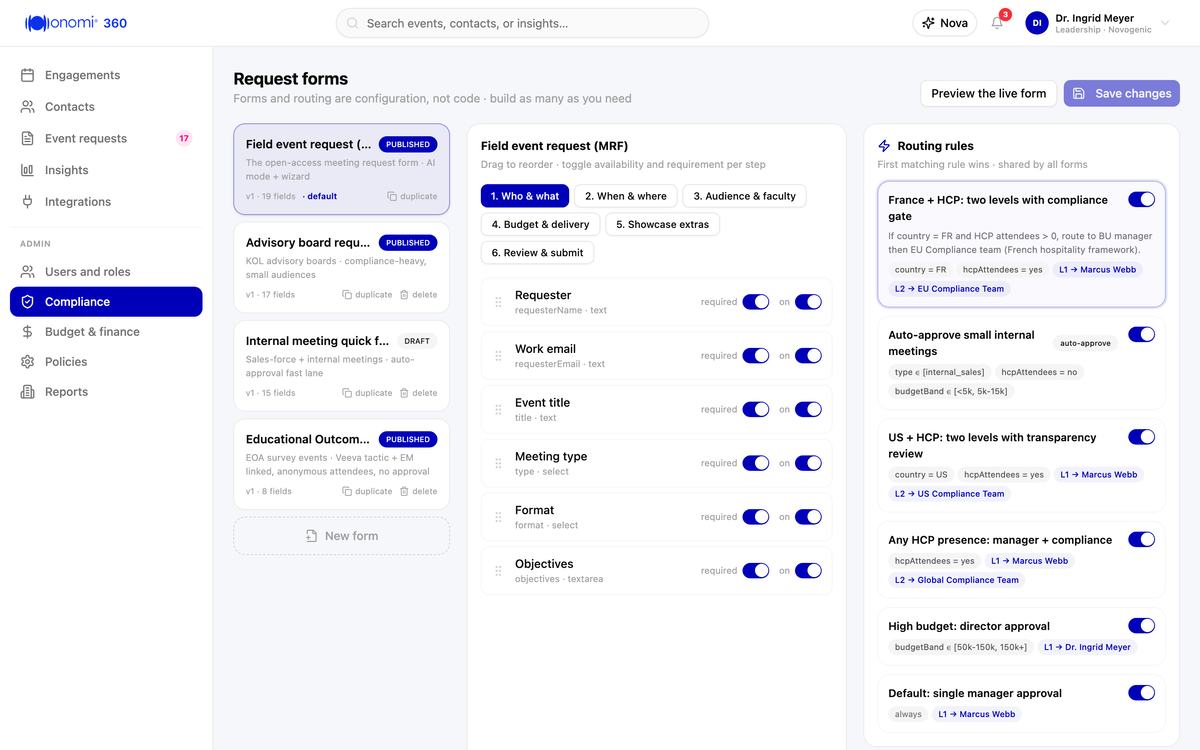
Routing rules combine country, attendee type, category, and budget band into ordered approval chains, and a compliance gate adds itself to a team inbox whenever HCP attendees are present - a function, not a person on vacation. Approvers can approve or decline inline from email, delegate, and escalate, auto-approval clears low-risk requests with the rule trace visible, and the audit trail keeps who cleared what, and why, on the record.
Money on the record from day one
Budget is captured at request and lives through the budgeted, committed, and actual states on the same event record. Meal caps are checked at request and again at reconciliation, cancellation is a first-class financial state rather than a deleted row, a named finance owner clears unmatched invoices, and reinvoicing summaries hand cross-charges to finance without re-keying.
Two deployment postures, one execution layer
Approve in-tool, or keep approvals upstream in Veeva Events Management and let Onomi execute the approved meeting - registration, engagement capture, budget actuals, and write-back. Both postures use the same record, so switching later is a configuration change, not a migration.
Featured services
Software is half of it. These are the services our team delivers around this capability.
Onomi Concierge
Vendor-side project management for your meetings program: setup, routing configuration, and adoption monitoring handled by our team rather than your admins.
Delivery & services →Implementation and rollout
A staged implementation model takes the program from kickoff to hypercare with named owners on both sides, market by market.
Delivery & services →24/7 support
Requesters and approvers get around-the-clock product support, so a stuck request the night before a meeting never waits for your admin's morning.
Delivery & services →Where this stops
Your ERP and procurement stay the systems of record
Onomi captures, tracks, and reconciles meeting spend, then hands reconciled actuals to your finance stack. Accounting and purchasing never move.
We route payment claims, your finance systems pay
Honoraria and reimbursements are tracked and attributed on the event record, and the payment itself always runs through your own finance processes.
"We already run meeting requests in Veeva Events Management."
Keep them there. In the upstream posture, approval stays in Veeva Events Management and Onomi picks up the approved meeting for execution, with attendance, engagement, and actual spend written back. You change nothing about how meetings get approved.
"Our occasional requesters will not adopt another tool."
They never see one. The self-service lane runs on a no-license tier: requesters submit and track through an SSO link, and approvers act directly from email. The full workspace is only for the people who run the program.
Frequently asked questions
Can approvals happen from email?
Yes. Approvers receive the request summary by email and can approve or decline inline without logging in. The action lands on the record with the same audit trail as an in-tool approval, and delegation and escalation rules cover absences.
How does the compliance gate work?
The gate is additive: whenever a request involves HCP attendees, a compliance review step inserts itself into the computed approval chain and routes to a team inbox rather than a named person. The record keeps the trace of which rule added the gate and who cleared it.
What keeps the budget accurate after approval?
The approved budget stays on the event record and moves through committed and actual states as bookings land and invoices arrive. Meal caps are re-checked at reconciliation, deviations need a recorded reason, and a named finance owner closes the event, so the final number is reconciled, not estimated.
What happens to declined or withdrawn requests?
They stay on the record with their state, reason, and history. Requesters can withdraw a pending request themselves, and declined requests keep the approver's reasoning, so the program view counts every request, not just the approved ones.
Related pages
See a request travel your own approval policy
Bring one real meeting type and its SOP. We will configure the form and routing rules live, and you watch a request go from plain-language intake to approved, with the budget on the record.
Request a demo