
Engagement you can measure as learning, not clicks
Attendance and satisfaction scores say nothing about whether the science landed. With Onomi, a library of named engagement tactics keeps HCPs active in the room, and pre and post assessments measure what they actually took away.
Runs at standalone medical education events, webinars, congress sessions, and advisory boards today.
What the current metrics hide
Attendance counted, learning assumed
The report says 120 HCPs attended and 4.5 out of 5 were satisfied. Whether anyone would now treat a patient differently is not in the report, because nothing measured it.
The room is passive and it shows
One-way slide delivery for 45 minutes, then silence at the Q&A. The HCPs with real questions never raise them, and the meeting ends with no trace of what the audience struggled with.
Every interactive idea is a custom build
The brand team wants a case discussion, medical wants a knowledge check, and each becomes a bespoke agency project instead of a setting.
How it works
A library of named tactics, not a blank canvas
Programs assemble from proven, named tactics, each with a stated intent and lifecycle phase: poster rating, digests and microlearning, knowledge trails, submit-your-case, interactive clinical journeys, decision pathways, build-your-agenda, personal learning paths, meet-the-expert and ask-the-expert formats, hot-seat Q&A, virtual libraries, and level-up challenges. Picking a tactic is a configuration choice, not a project.
Knowledge measured, not assumed
Pre and post assessments run around the session, and the knowledge-lift delta is segmented by country and specialty, so the program owner sees where the science landed and where it did not. Intent-to-change batteries ask the question that matters: will this change practice.
Participation that holds a room
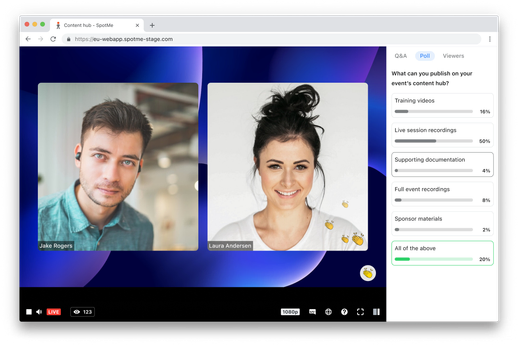
Polling is attributed to the identified HCP, Q&A runs with two-level moderation and upvoting so the room surfaces its real questions, live pulse checks read sentiment during the session, bring-your-own-case turns the audience into the agenda, and gamification converts points into charity donations rather than gimmicks.
What the room really thinks
The way HCPs phrase their questions is analyzed for sentiment and barriers, and unmet educational needs are summarized per event and per segment, so the next program is built on what this one revealed rather than on the satisfaction score.
Featured services
Software is half of it. These are the services our team delivers around this capability.
Onomi Concierge
Program design with the tactics matched to your learning objectives, configured and tested before the first session runs.
Delivery & services →SpotMe Academy
Role-based training so your event owners and moderators run tactics and assessments themselves after the first program.
Delivery & services →Where this stops
Assessment content is yours
Questions, cases, and answer keys are authored and approved by your medical team through your own process. Onomi runs them and measures the outcome; it never writes the science.
Measurement, not accreditation
Knowledge lift, participation, and certificates of attendance are delivered as data and documents. Formal CME accreditation stays with your accrediting partners.
"HCPs are tired of polls and gimmicks."
So is this page. Each tactic exists to serve a stated learning objective and is judged on knowledge lift and insight quality, not participation counts. A poll that teaches nothing gets cut from the next program, and the data shows which ones those are.
Frequently asked questions
How does knowledge assessment actually run?
A pre-assessment establishes the baseline, the session or program runs its tactics, and a post-assessment measures the delta. Results are attributed to identified HCPs and segmented by country and specialty, with intent-to-change questions alongside the knowledge items.
Can the same tactics run across formats?
Yes. The library is format-independent: the same knowledge trail or case discussion runs at a standalone event, inside a webinar, in a congress session microapp, or across an advisory board, and the results land on the same record.
Who moderates the interactivity?
Q&A supports two-level moderation: a first screen before questions become visible and a second before they reach the speaker, with upvoting deciding priority. Your team moderates, or ours does as a service.
What does the program owner see afterward?
Participation per tactic, knowledge lift by segment, sentiment and barrier analysis from how questions were phrased, and a summary of unmet educational needs, all exportable and written to the record for the next program to build on.
Bring one learning objective and see it instrumented
In the demo we take a real objective from your next program, pick the tactics that serve it, and show the knowledge-lift report your medical director would receive.
Request a demo