
- Elevating Events for Omnichannel Engagement
When Digital Competes With the Field: How to Make Webinars Work in Pharma
Designing webinars that strengthen the field force and improve HCP journeys.
Now available on-demand
Stefan Turnwald
Founder & CEO
CEEEcon
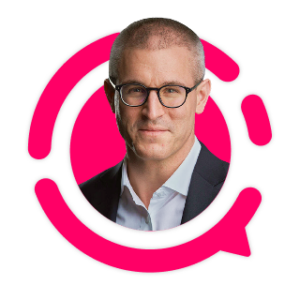
Pierre Metrailler
CEO
Onomi
About the webinar
In this on-demand episode, Pierre Metrailler (Onomi) and Stefan Turnwald (CEEEcon, Ex-Novartis) unpack the real tension most teams avoid: a webinar can either substitute the rep or strengthen the rep. This is where webinars become a make-or-break moment.
Here is a recap of what we covered, including the key moments, the practical example, and the operating model you can apply.
What stood out in the discussion
The central tension in this session was not about webinars. It was about the role of the rep. Stefan framed it clearly: are representatives treated as “communication channels” expected to deliver scripted messages, or as “engagement platforms that earn the right to engage” through relationship and trust? The moment reps become interchangeable with email, their perceived value to HCPs erodes.
That is the real driver behind the access problem most commercial teams are experiencing today.
Pierre connected this to what Onomi sees with pharma clients: webinar programs are often designed at HQ with the rep reduced to logistics. Pre-event engagement is centralized. Post-event follow-up is automated. The rep sends the invite and waits.
The poll reinforced it.
When it comes to webinar engagement in your organization, how is the field force typically involved?
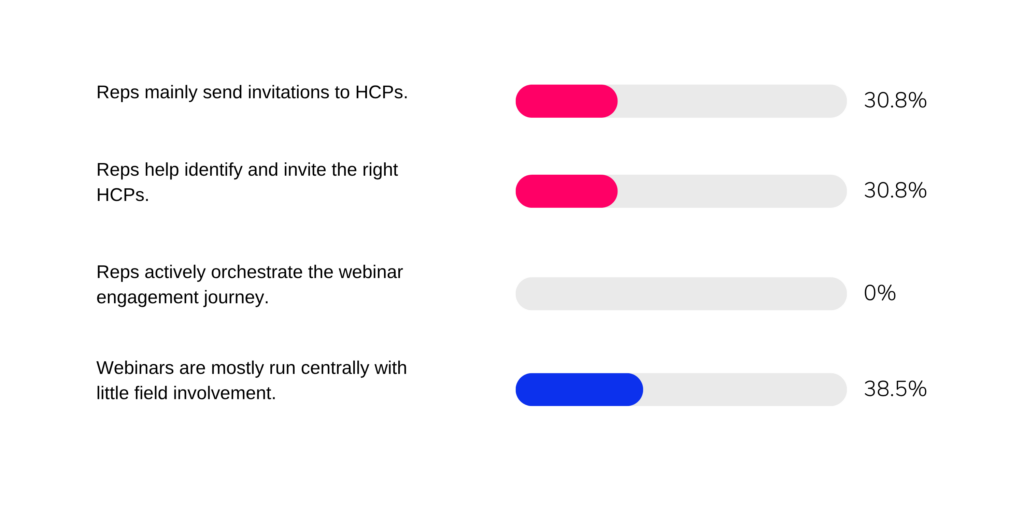
Nobody selected “reps actively orchestrate.” Not one person.
The key questions we covered
Why do HQ-led webinar programs unintentionally weaken the field?
Stefan: When a rep’s only task is dropping an invitation while pre- and post-event engagement is handled by HQ or third parties, the scientific and consultative value of that rep diminishes. The HCP’s question becomes simple: why open the door for a rep if the same information arrives by email?
Why does medical integrate webinars more naturally than commercial?
Stefan: Medical programs are typically designed at global or regional level and can be delivered locally without much adaptation. Commercial must adapt to local labels, compliance frameworks, and launch timing. That structural difference means medical webinars can be centrally organized and pushed down with minimal friction. Commercial cannot follow the same model. One size will not fit all.
What does "rep as producer" actually look like?
Pierre: The shift is from a calendar of 25 HQ webinars to a model where each rep actively manages participation. Reps see speaker availability, nominate HCPs, add personal context to invitations, and own the micro-journey before and after the event. HQ provides the content and compliance guardrails. The rep is the organizer, not the invite sender.
Who should own webinar outcome accountability?
Stefan: It depends on the purpose. If the goal is reach into the broader customer universe, HQ-led digital execution is appropriate. If the goal is deepening the rep-HCP relationship, accountability must sit with the field. The same webinar content can serve both models. The difference is in who owns the engagement around it.
Practical examples we shared
Pierre shared a screen demo of how Onomi 360 works in practice. The idea is a “calendar-first” approach: instead of reps reacting to a single HQ-scheduled webinar, they see a full timeline of past and upcoming webinars they can actively promote or reference in conversations.
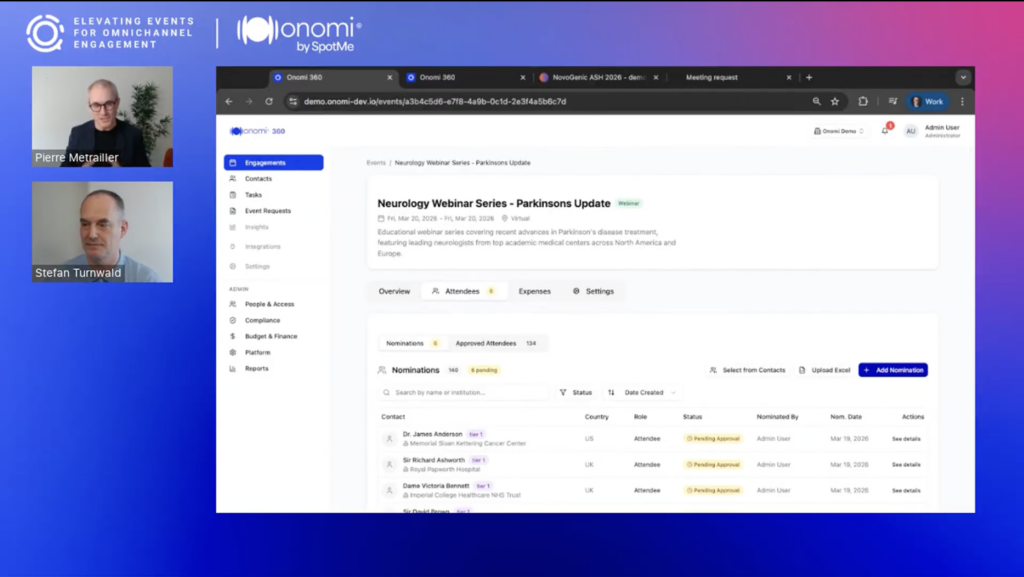
On speaker availability specifically: reps (or the team managing the program) can track when speakers are typically available. If a KOL is never free on Mondays and Tuesdays, that preference is logged. From there, a rep can request a new engagement, get fast approval, and pull together an invite list with personal context, essentially running their own “micro-event” with the right speaker at the right time.
The key point Pierre made: the rep becomes the organizer, not just the invite sender. And because HQ has full visibility into what is being set up, compliance and oversight are maintained.
The field-led 'micojourney' example
Stefan shared a case from a small country affiliate preparing for a product launch. Fewer than five reps faced a customer universe too large to cover with in-person visits alone.
The solution: reps extended their engagement journeys with webinars. HQ provided the scheduling and core content. But every pre-, peri-, and post-event touchpoint was owned by the rep. Each rep organized a minimum of 20 events, face-to-face and online, built around speakers and HCP preferences, with peer-to-peer referrals driving list expansion.
The webinar was not a broadcast. It was an entry point. Reps used invitations to open conversations with HCPs they had not reached before, asking existing contacts to recommend peers. The result was a growing network, not a static invite list.
Stefan’s analogy: “If you invite for a private party, you make sure your friends are there and maybe they bring interesting people. If you just use the same list from last year, you miss out.”
The takeaway
The tools exist to give reps full visibility into speaker availability, engagement history, and upcoming content. The question is not whether the technology can support a “rep-as-producer” model. It is whether your organization is designed to let it happen. As long as pre- and post-event engagement defaults to HQ, the rep remains a logistics step in a journey they should be owning.
Watch the full session on demand to see how this plays out in practice.
Speakers
Wait, what's Onomi again?
Onomi is a platform that helps pharma instrument scientific exchanges at congresses, webinars and advisory boards – connecting KOL engagement, booth insights, and symposium data into a single evidence layer integrated with your CRM.
With over 22 years of experience & trusted by 15 of the top 20 life science companies, Onomi creates engaging HCP experiences, measures real impact & is more cost-effective than traditional point solutions.