Turning KOL Data Into CRM-Ready Action With AI
About the webinar
In this on-demand episode, Sherry Crowe (OncoConnect) and Pierre Metrailler (Onomi) take on a problem most oncology teams recognize but few have solved: the gap between AI-generated KOL intelligence and field-ready insight that the commercial team can actually trust.
A central theme was that the problem facing oncology teams is rarely a shortage of data or tools. Most teams already invest in powerful platforms. The real issue is that AI outputs often look credible on the surface but carry inaccuracies that only become visible in front of a customer . A missing physician, an outdated affiliation, a misidentified KOL: these are not edge cases. They are predictable failure modes that damage trust in the field and slow follow-up at the moments that matter most.
Sherry’s framing was direct: data is everywhere, and insight is not . The gap between raw output and field-ready intelligence is where most engagement breakdowns actually happen. AI accelerates the process, but it cannot substitute for the judgment of someone who has spent years in the oncology ecosystem and knows what good looks like.
Pierre connected this to the CRM side: none of this intelligence creates commercial impact unless it is resolved, structured, and synced in time for the field to act. The value of a KOL insight, an advisory board signal, or a congress interaction decays quickly. Speed matters, but only if what reaches the field is accurate enough to use.
The key questions we covered
Why do AI outputs look convincing but still fail under scrutiny?
Sherry: Because the data is only as good as what is accessible online, in claims systems, or in the CRM, and those sources are not always current. Physicians move. Affiliations change. KOLs get misclassified as standard HCPs. Without a human layer that knows the landscape, those errors ship to the field as facts.
Why are most enterprise platforms so underutilized?
Sherry: Because the interfaces require a level of technical fluency that most commercial and medical teams do not have time to develop. Reps end up using expensive platforms to log calls, while the intelligence layer sits idle. The fix is not more training. It is a use-case-driven model where teams request specific answers and receive validated, field-ready outputs quickly.
How should oncology teams think about the KOL scheduling and data-matching challenge at congress?
Pierre: Workflows like KOL outreach, availability scheduling, and list matching against CRM records are high-volume and time-consuming. AI can automate a large share of that work. But the 5 to 10 percent of cases where the system gets it wrong are the ones that create downstream problems: wrong records, missed follow-ups, and relationships mapped to the wrong person. A human checkpoint at the right moment in the workflow preserves accuracy without eliminating the speed gains.
What does a better operating model actually look like?
Pierre: Signal capture has to come first. Interactions at congresses, in webinars, and during advisory boards need to be captured as structured, first-party behavioral data, resolved against real CRM identities, and synced in near-real time. That is the foundation that makes AI genuinely useful downstream. Without it, teams are working with incomplete inputs and wondering why the outputs do not hold up.
The practical model Sherry and Pierre outlined
The session walked through what a working AI-plus-human-QC approach looks like in practice. Rather than asking teams to navigate complex platforms themselves, the model works in three steps.
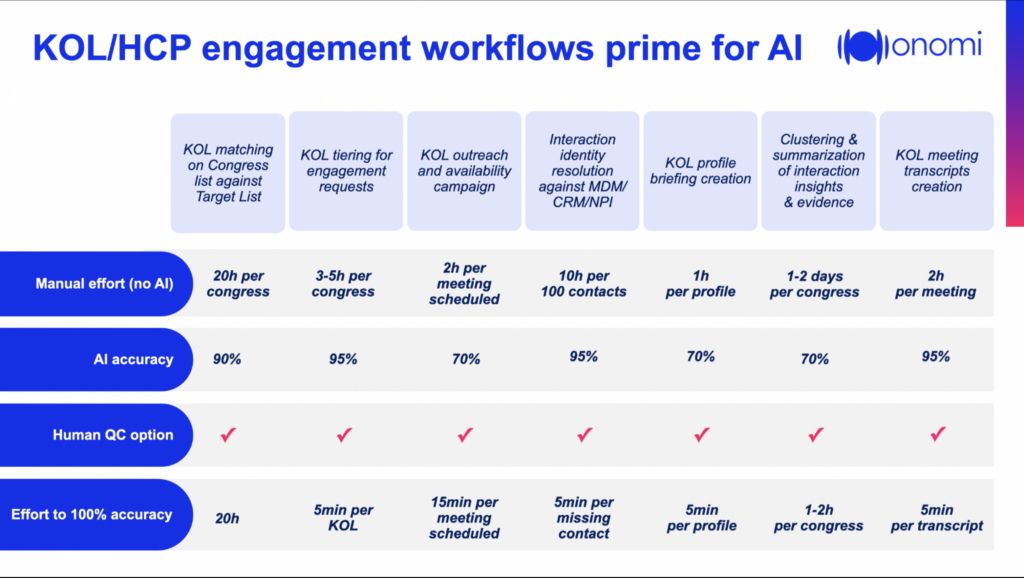
First, a use-case-driven request: the team specifies what they need, whether that is a validated KOL list ahead of ASCO, a competitive landscape for a specific indication, or engagement context for an advisory board. Second, AI generates a fast output from a rich data set. Third, an experienced human layer reviews it, catches inaccuracies, and delivers something the field can actually use, typically within one to two days.
On the congress side, Pierre showed how this same principle applies to real-time engagement workflows. When HCP interactions are captured at the booth, in a business suite meeting, or during a satellite symposium, resolved to a CRM record, and verified in the moment by the rep or MSL, the result is a signal that can trigger a next-best-action within minutes. Not a scan. Not a badge number. A contextual, verified interaction that makes the follow-up relevant.
The takeaway
AI speed without human quality control produces outputs that look right but erode trust the moment a rep relies on them. Human quality control without AI speed cannot scale to the volume and pace that oncology engagement demands today. The model that works combines both, anchored to a CRM that captures real HCP interactions at every touchpoint so the intelligence compounds over time.
Speakers
- Sherry Crowe — CEO, OncoConnect
- Pierre Metrailler — CEO, Onomi