
From Education to Intelligence: Pre-Launch Omnichannel Strategies That Win
About the webinar
In this on-demand episode, Daniela Clape (Xpeer) and Pierre Metrailler (Onomi) take on a problem most medical affairs and commercial teams recognize but few have solved: the gap between pre-launch HCP engagement and the decision-grade intelligence that commercial teams can actually act on before launch day.
Pre-launch medical affairs activity generates some of the richest HCP engagement in pharma. HCPs are actively signaling what they know, what they’re missing, and what might change their clinical behavior. The real problem is that almost none of it becomes usable intelligence. It stays in MSL notebooks, unstructured, disconnected from the commercial decisions that will determine launch success.
Daniela’s framing is direct: the industry is beginning to treat continuing medical education as a strategic lever for launch readiness, not an isolated medical activity. That shift requires two things most organizations have not yet built: content designed to generate behavioral signals, and integration that routes those signals to the people who need them before launch day.
Pierre connects this to the CRM side: even when consent exists and signals are captured, they tend to stay locked in the education platform where they were generated. The shift happening now is from collecting signals to connecting systems. APIs, data feeds, and CRM integrations are what move pre-launch intelligence from slide decks to decisions.
The key questions we covered
Why does pre-launch education fail to generate commercial readiness?
Daniela: Because most programs are designed to educate, not to capture movement. The content is not built to produce behavioral signals, and consent and integration are not built into the design from the start. When those two elements are absent, the data never leaves the platform.
What does education designed for behavior change actually look like in the data?
Daniela: It stops looking like attendance and starts looking like validated movement. That means 35-minute average watch times, 88% video completion rates, 90% opt-in rates from HCPs who received genuinely valuable content, 30% average knowledge lift, and 90% stated intention to change clinical practice. These are not vanity metrics. They are the inputs that commercial teams need to build real segmentation and personalized follow-up.
How should teams think about the signal architecture at congresses and scientific events?
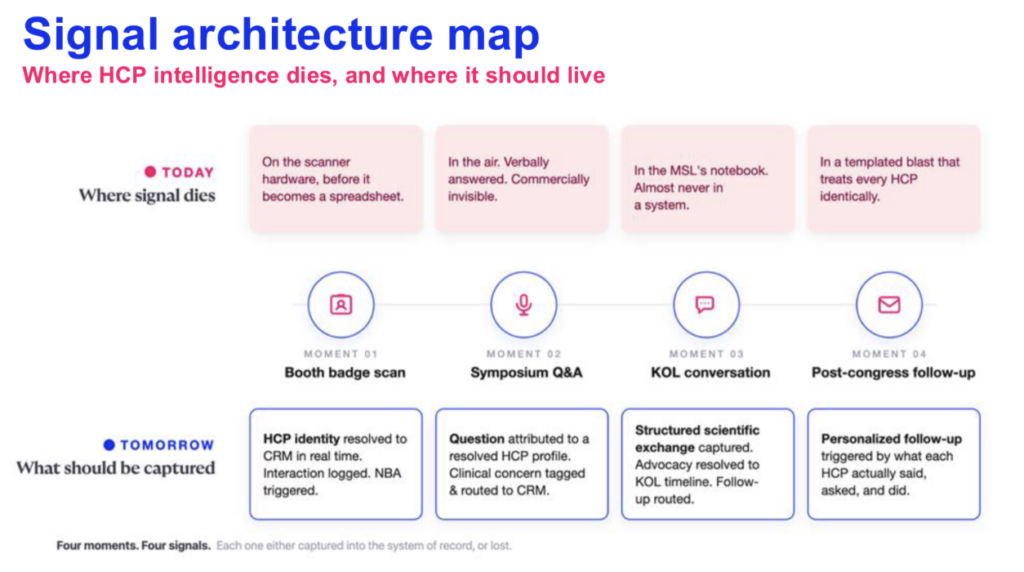
Pierre: At every congress, four moments consistently generate signals and consistently lose them: booth scans, satellite symposium Q&A, KOL conversations, and post-congress follow-up. When identity resolution and CRM sync are built into each of those moments, an MSL can log in the week after a congress and see exactly what a specific HCP asked during a symposium, and calibrate the next conversation accordingly. Without that infrastructure, the signal dies.
How do you connect pre-launch, launch and post-launch into one continuous engine?
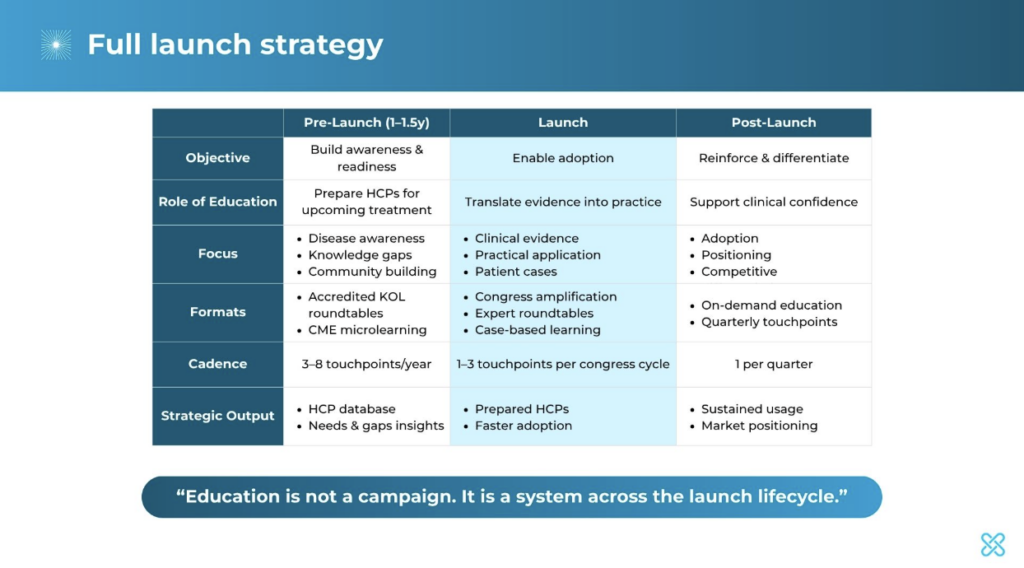
Daniela: The organizations getting this right treat education as a system across the product lifecycle, not a campaign. Pre-launch builds the audience and captures readiness signals. Launch translates evidence into practice through congresses and case-based formats. Post-launch reinforces and differentiates. When all three stages share a data layer, the system gets smarter every cycle, and HCPs experience a partner in education rather than a rotating series of promotions.
The practical model Daniela and Pierre outlined
The session walked through what a working pre-launch signal architecture looks like in practice. The foundation is consent and integration built into content design from day one: HCPs receive high-value, independently accredited education, and the consent flow that unlocks data sharing is a natural part of that experience, not a compliance checkbox bolted on afterward.
From there, secure identity matching through hashing allows pharma teams to recognize whether a specific HCP is in their target list, whether that person completed modules, and how deeply they engaged, without passing personally identifiable data between platforms. That is the difference between activity data and decision-grade data.
On the congress side, Pierre showed how the same principle applies. When interactions are captured at the booth, in satellite symposia, and during KOL meetings, resolved against CRM records in near real time, and routed to the right MSL, the result is a follow-up that is relevant to what an HCP actually said and asked. Not a generic post-congress email blast. A calibrated conversation.
The takeaway
Pre-launch signals shouldn’t die after day one. The organizations building durable launch advantage are the ones designing their medical education and congress engagement to generate structured, identity-resolved, CRM-ready behavioral data from the first touch. That data feeds launch. Post-launch validates and reinforces it. The system compounds over time, and trust with HCPs builds with it.
Speakers
- Daniela Clape — Founder & CEO, Xpeer Medical Education
- Pierre Metrailler — CEO, Onomi